— Ural Owl Project —
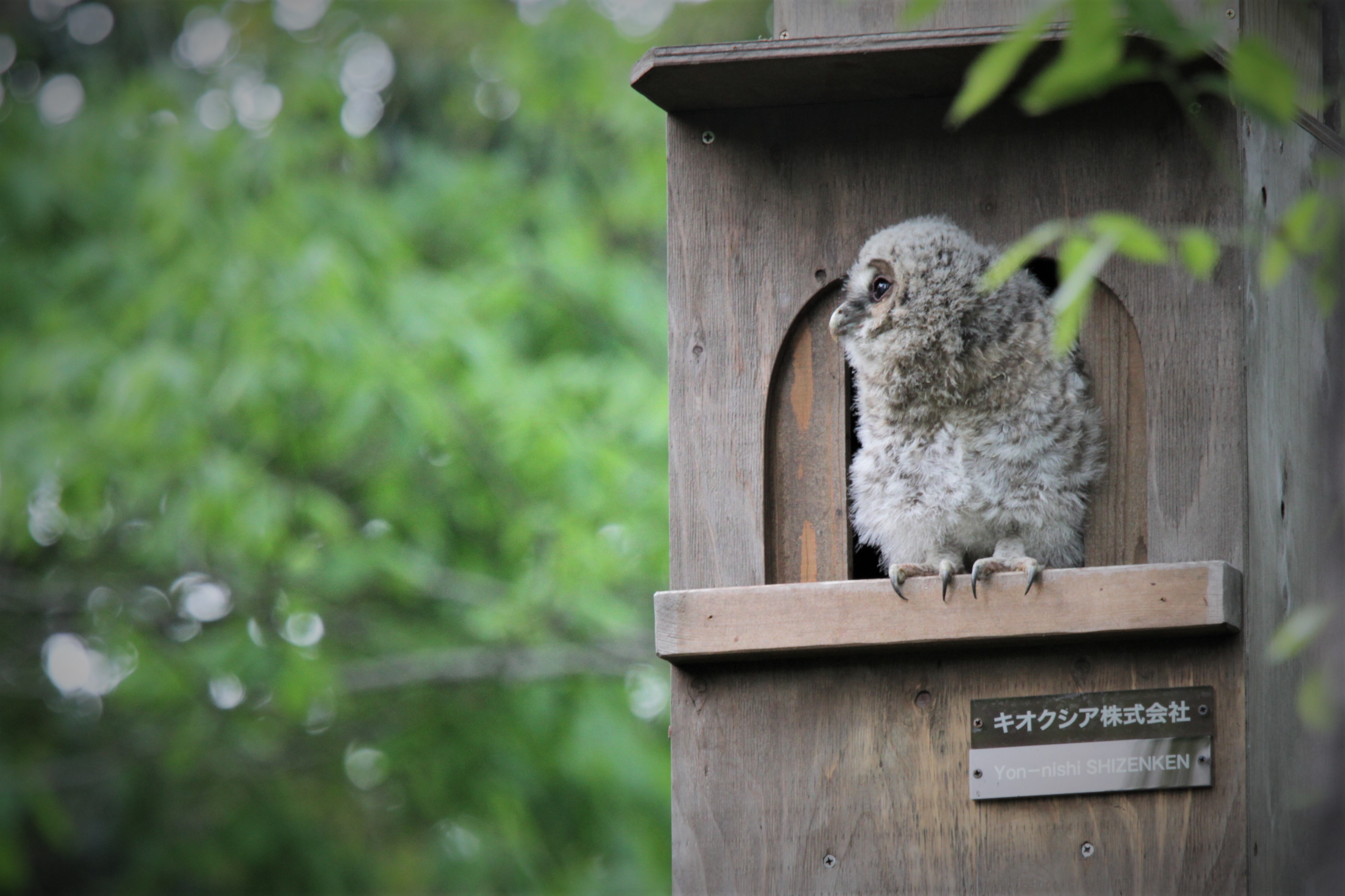
A Story of Ural Owl Conservation Built by High School Students and
Teachers
The Ural Owl conservation project began in 2015 at the foothills of the Suzuka Mountains in
northern Mie Prefecture, Japan.
At that time, a teacher who was advising a high school nature research club at Yokkaichi
Nishi High School heard the call of a Ural Owl (Strix uralensis) together with students one
evening after the rain. Inspired by that moment, the teacher and students immediately began
researching nest boxes, building them by hand, and installing them in the forest.
Yokkaichi City’s coastal area has a history of serious industrial pollution, but today it has
been revitalized and is recognized as an environmentally advanced region.
At the same time, due to changes in forest environments and land development, the Ural
Owl has been designated a Near Threatened species within Mie Prefecture.
From a simple question — “Could we protect this owl as a symbol of our local natural
environment?” — a student-led conservation effort was born.

Conservation Rooted in a School-Based Club Activity
The foundation of this project lies in Japan’s high school club activity system. With guidance
from teachers serving as advisors, students use after-school time, weekends, and long
vacations to engage in nest box installation, ecological research, and community outreach
activities.
Unlike typical volunteer organizations, this project has continued within the framework of
school education, passing from one generation of students to the next. This continuity
through generational change is one of the project’s defining characteristics.
Students researched nest box initiatives across Japan and designed and built large nest
boxes themselves. In the spring of 2016, breeding by Ural Owls was confirmed for the first
time in one of the seven nest boxes installed, and the chicks successfully fledged. This
milestone marked the formal launch of the project under the name “Ural Owl Project.”
Accumulating Research Through Nest Box Installation
To date, more than 70 nest boxes have been installed, mainly around the Suzuka Mountain
range. The nest boxes are designed with durability, safety, ease of maintenance, and
minimal impact on other wildlife in mind. Students, wearing appropriate safety equipment,
install the boxes at heights of approximately 5–6 meters.
We also regard the Ural Owl as an umbrella species, emphasizing that its protection
contributes to the conservation of broader forest ecosystems and biodiversity. After the

breeding season, pellets (regurgitated remains of bones and fur) left in the nest boxes are
collected and analyzed to study diet and ecology. These analyses have revealed, for
example, that local Ural Owls primarily feed frogs to their chicks.

Encountering Technology and Moving to the Next Stage
In 2018, with corporate support, camera systems were introduced inside the nest boxes to
record breeding behavior on video. By combining pellet analysis with visual data, the
accuracy and depth of research improved significantly.
From January 2026, the camera system was further upgraded, enabling 24-hour remote
observation of the nest boxes. This allows students to observe owl behavior in real time
while at school and to engage in new research opportunities based on continuous
monitoring.

Expanding Collaboration and Passing the Baton to the Next Generation
In 2021, following my transfer to another school as a high school teacher who had led the
project, new schools — Kuwana High School and Kuwana Nishi High School — joined the
initiative. A Biodiversity Team was established at these schools, and students now work in
collaboration with local NPOs and organizations on research, outreach, and nest box
installation.
While teachers remain continuously involved as mentors, students pass the project on to the
next generation when they graduate. Some former participants have gone on to study
ornithology and conservation biology and to pursue careers related to nature and
environmental protection.
What We Value
The Ural Owl Project is built on three pillars: conservation, research, and education.
Protecting the Ural Owl is both our goal and our starting point. Through this work, students
come to understand their local natural environment, think deeply about conservation, and
carry these values forward to future generations.
This project represents a long-term, collaborative effort — one that has grown over time
through cooperation among high school students, teachers, and the local community.
Website: www.uralowlproject.org
Instagram: uralowlproject


Comments